Why Proper Installation of Concrete Garage Floors Matters
The garage floor is one of the most overlooked concrete surfaces on a residential property — until it starts failing. Homeowners rarely think about garage floors until cracks appear, the surface begins to dust and deteriorate, or sections start to sink and separate. By that point, what might have been a straightforward installation issue has become a more involved and expensive problem to correct.
A garage floor is not just a slab of concrete poured into a box. It bears the weight of vehicles every day, absorbs oil and chemical spills, cycles through dramatic temperature swings between summer heat and winter cold, and takes impact from dropped tools and equipment. A properly installed garage floor handles all of that reliably for decades. A poorly installed one shows its weaknesses within a few years — sometimes sooner.
For homeowners in Addison and the surrounding western suburbs, understanding what proper garage floor installation involves is the best way to know whether an existing floor needs attention and what to expect from a replacement.
Why Garage Floors Fail: The Most Common Causes
Inadequate sub-base preparation is the leading cause of garage floor cracking and settlement. Concrete needs a stable, compacted base to rest on. When the sub-base material is poorly compacted, contains organic material, or shifts with seasonal moisture changes, the slab above it moves — and concrete that moves cracks. In the western suburbs, where soils can contain significant clay content that expands when wet and shrinks when dry, base preparation is especially critical.
Water under the slab is a related problem. Garages that lack proper moisture barriers between the soil and the concrete allow ground moisture to migrate into the slab from below. This contributes to freeze-thaw damage, weakens the concrete over time, and can cause efflorescence — the white mineral deposits that appear on concrete surfaces as water carries salts to the surface and evaporates.
Too much water in the mix is a common installation shortcut that produces a weaker slab. Adding water to a concrete mix makes it easier to pour and spread, which is more convenient on the job site. But excess water increases the water-to-cement ratio, producing concrete with lower compressive strength, higher porosity, and a surface that dusts and deteriorates more quickly. A mix that is convenient to place is not necessarily a mix that performs well over time.
Insufficient curing time and conditions also contribute to long-term failure. Concrete gains strength through a chemical hydration process that requires adequate moisture and temperature. When concrete dries too quickly — which can happen in summer heat or when curing compound isn't applied — it doesn't achieve its design strength. A slab that was never given the right conditions to cure properly is weaker than it should be for its entire service life.
The Right Concrete Mix for Garage Floors
Garage floors in Illinois should be specified at a minimum compressive strength of 4,000 PSI — the same standard as pool decks and other demanding exterior applications. The higher strength produces a denser, harder surface that resists abrasion from vehicle tires, holds up under point loads from jacks and equipment, and is more resistant to oil and chemical penetration.
Air entrainment is important even for garage floors, which many homeowners assume are sheltered from freeze-thaw conditions. In Illinois, garages are rarely climate-controlled. Temperature inside an unheated garage can swing well below freezing in winter, and moisture from snow tracked in by vehicles, humidity, and any ground moisture that migrates through the slab creates real freeze-thaw exposure. Air-entrained concrete handles those cycles better than non-air-entrained mixes.
A low water-to-cement ratio — achieved by keeping mix water to the minimum necessary for workability — is the single most controllable variable that affects concrete quality on the job site. Experienced
concrete garage floor contractors specify the right mix and don't allow it to be diluted in the field.
How Thick Should a Garage Floor Be?
Slab thickness is one of the most common questions homeowners ask when planning a garage floor project, and one of the most commonly underspecified aspects of lower-cost installations.
For a standard residential garage used for passenger vehicles, a minimum of four inches is the accepted standard. However, five to six inches is a better specification for garages that will see heavier use — trucks, SUVs, recreational vehicles, or storage of heavy equipment. Thicker slabs distribute vehicle loads over a larger area of the sub-base, reducing the stress on any single point and decreasing the likelihood of cracking under load.
Consistent thickness throughout the slab matters as much as the average. Thin spots — which occur when sub-base grading is uneven and the contractor doesn't correct for it before the pour — are stress concentration points. Cracking almost always initiates at the thinnest section of a slab.
Reinforcement with fiber mesh, wire mesh, or rebar adds tensile strength to the slab and helps control crack width if cracking does occur. For garage floors, fiber mesh is commonly used as a practical and effective reinforcement option. Rebar or wire mesh may be specified for heavier-duty applications or for slabs over less stable sub-bases.
Control Joints: Designed Cracking vs. Random Cracking
Concrete shrinks slightly as it cures and continues to expand and contract with temperature changes over its service life. That movement produces internal stress, and when that stress exceeds the concrete's tensile strength, it cracks. The question isn't whether a concrete slab will crack — it's whether those cracks will occur randomly across the surface or along intentional control joints where they can be managed.
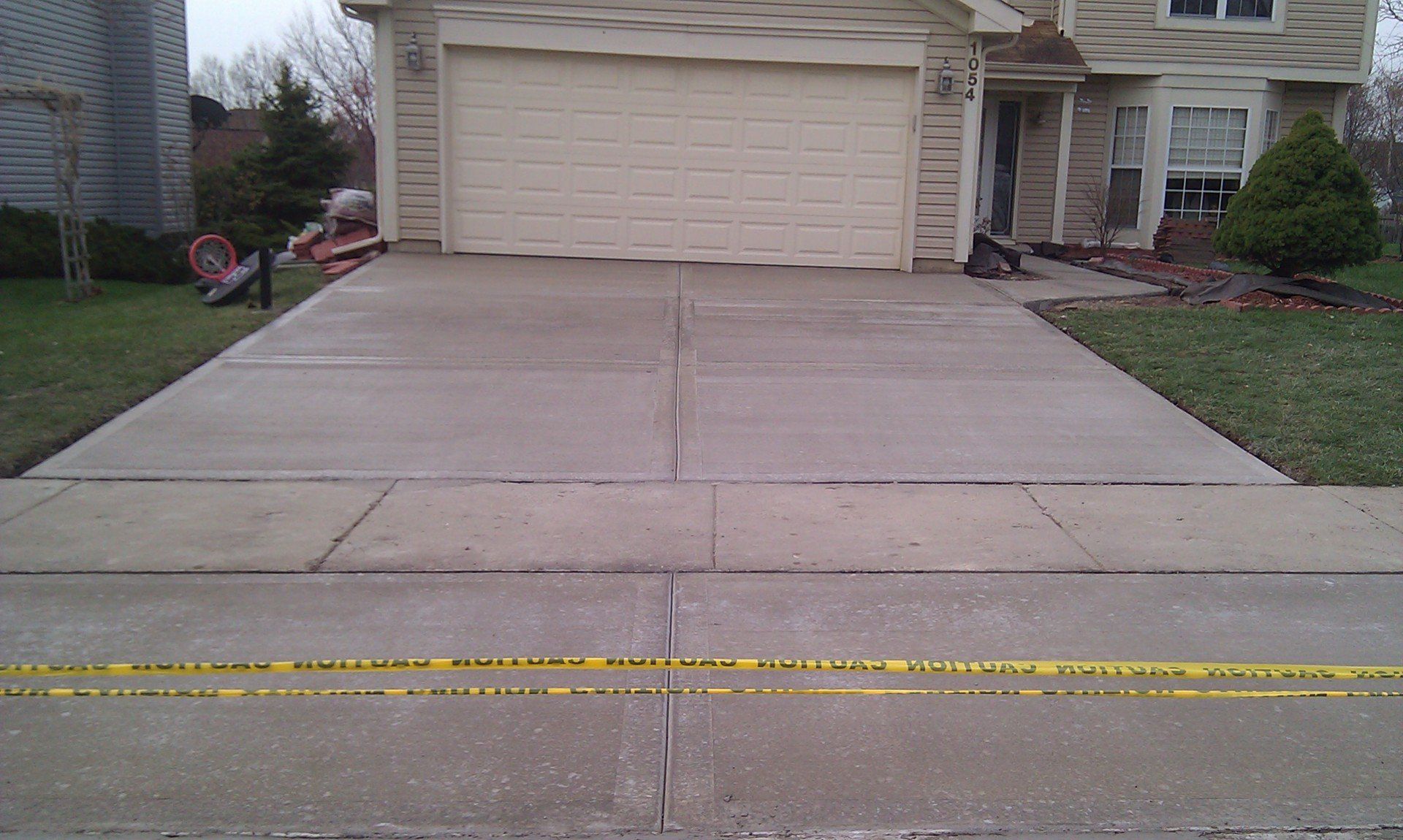
Control joints in a garage floor are typically cut with a saw within the first 24 hours after the pour, creating weakened planes that encourage cracking to follow a predictable, planned path. Proper joint spacing for a garage floor is generally no more than 10 feet in any direction — so a standard two-car garage requires at least one interior joint to properly manage shrinkage cracking.
Joints that are cut too late, too shallow, or spaced too far apart result in random cracking that is both harder to control and less attractive than intentional joints. This is a detail that is easy to overlook or shortcut, and one that experienced contractors take seriously because it directly affects how the floor looks and performs long-term.
Surface Finish Options for Garage Floors
The finish on a garage floor affects both its appearance and its function. Several options are appropriate for residential garage applications.
Broom finish is the standard choice — a medium-texture surface created by dragging a broom across the freshly poured concrete. The texture provides traction, hides minor surface imperfections, and is easy to maintain. It is the practical choice for most residential garages and the right baseline if coatings or sealers will be applied later.
Steel trowel finish produces a smooth, dense surface that is harder and less porous than a broom finish. It is more resistant to oil and staining and easier to clean, but it requires more skilled finishing labor and can be slippery underfoot when wet. A trowel-finished garage floor is often preferred when epoxy coatings or decorative sealers will be applied over the top, as the smoother surface bonds well with coating systems.
Exposed aggregate is less common for garages but can be appropriate when the garage space is also used as a workshop or recreational area and aesthetics matter more than typical.
Temperature Swings and Garage Floor Durability
Garages in Addison and throughout DuPage County experience significant temperature extremes — summer temperatures pushing toward 90°F inside a closed garage, winter temperatures well below freezing in an unheated space. That range can span 100 degrees or more over the course of a year, and concrete expands and contracts with every swing.
This is why control joints, proper mix design, and sealing are not optional upgrades — they are baseline requirements for a garage floor that holds up through Illinois seasons. An unsealed garage floor absorbs moisture from snow melt and humidity, then cycles through freeze-thaw damage every winter. A floor without adequate control joints develops random cracking as seasonal movement accumulates over years.
Homeowners who invest in a properly installed
residential concrete garage floor get a surface that handles those extremes reliably. The difference between a floor that lasts 30 years and one that begins failing at 8 or 10 is almost entirely determined by what happened during installation.
When to Repair and When to Replace a Garage Floor
Not every damaged garage floor requires full replacement. The right call depends on the type and extent of damage.
Repair is appropriate when cracks are isolated and hairline-sized, surface dusting or scaling is limited to small areas, and the structural slab beneath is still sound and level. Minor cracks can be filled with concrete crack filler, and surface coatings can address light dusting.
Replacement is the better investment when cracking is widespread or structural, significant sections have settled or heaved, the surface is scaling across large areas, or the floor has been previously repaired multiple times without lasting results. A garage floor with a compromised sub-base will continue to move and crack regardless of surface treatments applied over it.
RJ Concrete provides garage floor assessments throughout Addison,
Naperville and the surrounding western suburbs. If you're unsure whether your floor is a repair or replacement candidate, a professional evaluation is the most reliable way to get a clear answer and a cost-effective recommendation.
Frequently Asked Questions
Why do garage floors crack?
Garage floors crack primarily because of sub-base movement, insufficient slab thickness, control joints that are absent or poorly placed, and seasonal temperature swings that cause the concrete to expand and contract. A concrete mix with too much water — which reduces compressive strength and increases porosity — also contributes to cracking over time. In Illinois, freeze-thaw cycles add additional stress to garage floors that are exposed to moisture from snow melt and temperature changes in unheated spaces.
How thick should a concrete garage floor be?
A minimum of four inches is the accepted standard for residential garage floors serving passenger vehicles. Five to six inches is a better specification for garages that will house trucks, SUVs, or heavy equipment, or where sub-base conditions are less than ideal. Consistent thickness throughout the slab is equally important — uneven thickness creates stress concentration points where cracking begins.
What concrete strength is right for a garage floor?
A minimum compressive strength of 4,000 PSI is recommended for garage floors in Illinois. Higher-strength mixes produce a denser, more abrasion-resistant surface that holds up better under vehicle loads and is more resistant to oil and chemical penetration. A low water-to-cement ratio is the key variable on the job site — adding excess water to the mix for ease of placement weakens the finished slab.
How long does a concrete garage floor last?
A properly installed concrete garage floor in Illinois typically lasts 25 to 30 years or more. Longevity is determined primarily by installation quality — sub-base preparation, mix design, slab thickness, and control joint placement — and by basic maintenance such as periodic sealing and prompt crack repair. Floors installed with shortcuts tend to show significant deterioration within 10 to 15 years, sometimes sooner.
Should a garage floor be sealed?
Yes. Sealing a garage floor protects against oil and chemical penetration, reduces dusting, and limits moisture infiltration that drives freeze-thaw damage. A penetrating concrete sealer is appropriate for standard broom-finished floors. Epoxy coatings provide a more durable, easier-to-clean surface for homeowners who want a finished garage appearance. Sealers should be reapplied periodically as they wear, typically every two to three years depending on product and use level.
Can a cracked garage floor be resurfaced instead of replaced?
Resurfacing is appropriate when the existing slab is structurally sound and the damage is limited to the surface. If the slab has significant structural cracking, sections that have settled or shifted, or a compromised sub-base, resurfacing will not address the underlying problem. The new surface layer will reflect the same structural issues within a short period. A professional assessment is the most reliable way to determine whether resurfacing or replacement is the right solution for a specific floor.
Is a vapor barrier necessary under a garage floor?
A vapor barrier — typically a layer of polyethylene sheeting placed between the compacted sub-base and the concrete — limits moisture migration from the ground into the slab. In Illinois, where seasonal moisture levels vary significantly, a vapor barrier is a worthwhile investment. Without it, ground moisture can migrate through the slab and contribute to freeze-thaw damage, surface efflorescence, and reduced bond strength for any coatings applied later.